On the occasion of the 2021 International Day of Girls I took a few minutes to reflect and share my thoughts on how to raise Girls holistically.Click and Follow this link to watch more
Please take a moment to watch my video and thereafter, please feel free to join the conversation.
It is also part an ongoing community education and sensitization project that I am currently carrying out.
One thing I planned on doing upon my arrival in Rome was to go to an open international market to buy some African food items . Sooooo I rang my longtime friend Jeanne to help me locate one and yesssss....we set out to visit the "Emmanuel Emiele" market down town Rome.
You can tell by the excitement on my face!
Guess what....I just spotted items like plantains, yams, cocoyams, palm oil, stuck-fish, crayfish, yam flour.....almost everything I had on my market list.
Now this feels like I am home!
I am tempted to buy each item...and so my friend Jeanne is teasing me about wanting to buy the entire market ( laughing😃) . I am such a foodie guys so you can imagine how my face lit up right ....!By the way have you visited my food blog @ Akwe's cuisine?
In Cameroon, we eat cocoyams in various forms. My staple food is achu served with achu soup ( yellow soup) . Achu is made from pounded cocoyams while the soup is made by using a combination of traditional spices, a variety of beef, palm oil, and limestone ( locally called kangwa) . I even saw kangwa at the market....yes "kangwa".
It was a great day we had exploring the market. We bought a variety of African food items before leaving the market.
Thank you Jeanne for your immense help .
Pictures courtesy of Jeanne Faye and Mabi Azefor Fominyen.
Did I ever mention that I love eating grapes? Well, I simply can't get over these very sweet and juicy grapes. Since my arrival in Rome, I can't stop harvesting these fresh grapes 🍇 from our yard !
Simply irresistible!
I can't stop eating them!
I love having them after meals! Let me hurry up now to wash these .....so I can leave them in the fridge to get cold a bit.
Do you love eating 🍇 grapes? Let me hear from you .
By Mabi Azefor Fominyen.
Christmas 2020 is fast approaching ! What a challenging year it has been for many people the world over, due to the ravaging effects of the COVID- 19 . As a result of this global pandemic, many families have lost their loved ones, colleagues have lost their team members, doctors , nurses, other essential workers have lost their lives on the line of duty , all because of Coronavirus. Many people the world over continue to suffer and die even as I write this post because of COVID-19.
As the year 2020 ebbs out, I am just so grateful to be alive.
I would like to wish everyone a beautiful Christmas holiday and a wonderful 2021.
I can't wait to see what 2021 brings!
In the meantime I pray we all continue to trust God even as we pray for protection, good health, wisdom, long life etc.
If you are a woman working in the media, you have probably come across people asking you what it is like, being and working in the media. I am guessing your answer would be based on your experience.
As you think about this, permit me share this interesting article written by Destiny Alvarez in which four women are sharing their experiences.
Women have been fighting for equality and their place in the workforce for decades, and while successful in some cases, the battle still continues. For women in media, careful consideration for diversity and actively supporting each other plays a key role in navigating gender normative roles in the workplace.
Each term, the University of Oregon invites leading media professionals and academics to participate in the “Demystifying Media” seminar series, launched in 2016. While the seminar speakers come from a diverse pool of media professionals, the series’ latest term featured four women — a first in the seminar’s history.
Last spring, award-winning data journalist Jennifer La Fleur, journalism professor Dr. Susan Robinson, climate change researcher Rosalind Donald, and McClatchy’s Mandy Jenkins, at the time a JSK Fellow at Stanford, spoke to students and faculty.
Alongside sharing details of their work, they shared their own experiences as women in the media industry. Based on one-on-one interviews, here are some of their key reflections on the opportunities — and challenges — for women in media.
Quotes have been edited for brevity.
Mandy Jenkins, McClatchy
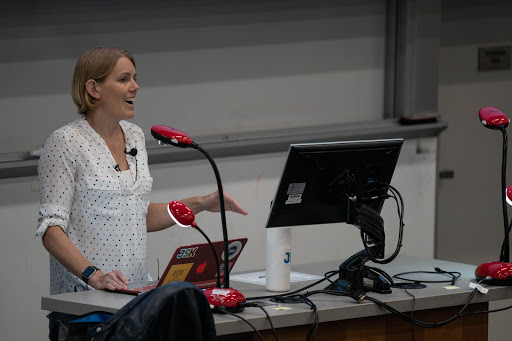
Mandy Jenkins speaking at the University of Oregon in Spring 2019. Image via OR Media.
While many journalists abide by the motto “don’t read the comments,” Mandy Jenkins, the General Manager for The Compass Experiment, a local news laboratory founded by McClatchy and Google, said reading and responding to people who care enough to engage with them is an important part of a journalist's job. Engaging is also a key tenet of social journalism, which is using social media to engage audiences, distribute information and more.
“I think the rise of social journalism is very much tied to the rise of women,” said Jenkins. “There are a lot of women that are making big impacts in journalism, but we’re still not seeing that change at the top. I think that’s going to take a lot longer.”
“I have my own theory as to why women are being able to make big leaps in journalism right now,” she added. “At one time women were regulated into arts and community coverage. Later on, for example, when I came into the field, it was all social journalism jobs.”
Jenkins said that when she entered the field, jobs in digital journalism, social media and community engagement were not as sought after and considered “low on the totem pole.” Print was still at the forefront of journalism, so it was easy for women to slip into those jobs and, as a result, women came to dominate those positions.
“Women have been able to rise up through the ranks in these jobs because they used to be ones that no men wanted. With the jobs having gotten bigger, the women in these positions have been getting bigger. A lot of these women are slowly moving into high up positions, like top editor positions now.”
Jenkins visited the University of Oregon as a Journalist in Residence during her time as a 2019 John S. Knight Fellow at Stanford University. During her lecture, she discussed her career and recent research into disinformation and mainstream news.
Rosalind Donald, Columbia University
Rosalind Donald is a former journalist and deputy editor of Carbon Brief, a fact‐checking website focused on climate science and policy in the media. Currently a Ph.D. candidate and researcher at Columbia Journalism School, her work focuses on community understanding of climate change; a topic she argued could be a part of any journalistic beat.
“Reporting on climate change or science can be difficult,” said Rosalind Donald, a former journalist and deputy editor of Carbon Brief and a current Ph.D. candidate and researcher at Columbia Journalism School. “You have people saying you shouldn’t be in this area because it’s a science area. Women in science and in complex fields deal with that every day. It’s not just journalists.”
You can continue reading the rest of the article by clicking here