If you are a woman working in the media, you have probably come across people asking you what it is like, being and working in the media. I am guessing your answer would be based on your experience.
As you think about this, permit me share this interesting article written by Destiny Alvarez in which four women are sharing their experiences.
Women have been fighting for equality and their place in the workforce for decades, and while successful in some cases, the battle still continues. For women in media, careful consideration for diversity and actively supporting each other plays a key role in navigating gender normative roles in the workplace.
Each term, the University of Oregon invites leading media professionals and academics to participate in the “Demystifying Media” seminar series, launched in 2016. While the seminar speakers come from a diverse pool of media professionals, the series’ latest term featured four women — a first in the seminar’s history.
Last spring, award-winning data journalist Jennifer La Fleur, journalism professor Dr. Susan Robinson, climate change researcher Rosalind Donald, and McClatchy’s Mandy Jenkins, at the time a JSK Fellow at Stanford, spoke to students and faculty.
Alongside sharing details of their work, they shared their own experiences as women in the media industry. Based on one-on-one interviews, here are some of their key reflections on the opportunities — and challenges — for women in media.
Quotes have been edited for brevity.
Mandy Jenkins, McClatchy
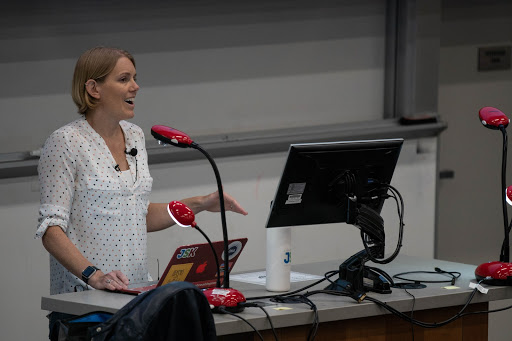
Mandy Jenkins speaking at the University of Oregon in Spring 2019. Image via OR Media.
While many journalists abide by the motto “don’t read the comments,” Mandy Jenkins, the General Manager for The Compass Experiment, a local news laboratory founded by McClatchy and Google, said reading and responding to people who care enough to engage with them is an important part of a journalist's job. Engaging is also a key tenet of social journalism, which is using social media to engage audiences, distribute information and more.
“I think the rise of social journalism is very much tied to the rise of women,” said Jenkins. “There are a lot of women that are making big impacts in journalism, but we’re still not seeing that change at the top. I think that’s going to take a lot longer.”
“I have my own theory as to why women are being able to make big leaps in journalism right now,” she added. “At one time women were regulated into arts and community coverage. Later on, for example, when I came into the field, it was all social journalism jobs.”
Jenkins said that when she entered the field, jobs in digital journalism, social media and community engagement were not as sought after and considered “low on the totem pole.” Print was still at the forefront of journalism, so it was easy for women to slip into those jobs and, as a result, women came to dominate those positions.
“Women have been able to rise up through the ranks in these jobs because they used to be ones that no men wanted. With the jobs having gotten bigger, the women in these positions have been getting bigger. A lot of these women are slowly moving into high up positions, like top editor positions now.”
Jenkins visited the University of Oregon as a Journalist in Residence during her time as a 2019 John S. Knight Fellow at Stanford University. During her lecture, she discussed her career and recent research into disinformation and mainstream news.
Rosalind Donald, Columbia University
Rosalind Donald is a former journalist and deputy editor of Carbon Brief, a fact‐checking website focused on climate science and policy in the media. Currently a Ph.D. candidate and researcher at Columbia Journalism School, her work focuses on community understanding of climate change; a topic she argued could be a part of any journalistic beat.
“Reporting on climate change or science can be difficult,” said Rosalind Donald, a former journalist and deputy editor of Carbon Brief and a current Ph.D. candidate and researcher at Columbia Journalism School. “You have people saying you shouldn’t be in this area because it’s a science area. Women in science and in complex fields deal with that every day. It’s not just journalists.”
You can continue reading the rest of the article by clicking here
I came across this article and I felt it was necessary to share with others.
I am not the author. The article brings out some of the major challenges and hurdles that continue to hold back many girls and women in Nigeria as well as in other parts of the world.
Group calls for empowerment of the girl-child in Nigeria (By Ali Garba)
A group, West Africa Network for Peace-building Nigeria (WANEP-Nigeria) has expressed concern over issues still besieging the girl-child in the country.
WANEP-Nigeria observed that; “issues like early marriage, female genital mutilation, education inequality, gender-based violence, low self-esteem, human trafficking, poor health and sanitation are some of the numerous problems that continue to pose challenges for girls.”
This was contained in a statement signed by WANEP-Nigeria Board Chairman, Mr. Abiola Akiyode-Afolabi, copies of which were made available to journalists in Bauchi yesterday.
Please click here or on the link below to read the original story.
In what I prefer to describe as getting back in to the game- the next step in the life of a media personality, it has been yet another fascinating experience for me over the last couple of months , as I returned to radio. I began producing and presenting programmes and news on West Africa Democracy Radio !
Hence, dusting off the years when I had moved away from everyday journalistic work, and from the daily routine of programme planning, actual production and presentation of radio programmes and newscasts!
Luckily I had managed to keep the professional reflexes over the years and so it was easy to catch up really fast and swing back in to action once it was time.
Of course so much has happened as well as changed over these years!
For instance, this time around I am in West Africa. Back when I started journalism practice, I used to work in my home country Cameroon situated in West-Central Africa, where I spent close to a decade doing journalistic work and radio and Television (CRTV-Cameroon's National broadcaster).
Far from what obtained back then, radio production equipment have evolved over these years. New and digital recorders are in plenty. Editing soft-wares have gradually replaced the old editing machines and methods that producers and journalists used several years back. Mobile Phone lines have made it even easier to reach out to resource persons in other parts of the world to get their perspectives and add value to specific topics and issues being handled on programmes. The use of the world wide web to gather information and build content for different productions has been a plus. The availability and the use of social media platforms have also made it easier to share programmes online and reach out to a wider audience beyond the scope and the broadcast zone of radio stations.
In a nutshell, it has gotten better over time !
Perhaps my quest to remain professional, and religiously respect the rules and ethics of the journalism profession is what I have held unto, in spite of the changing times . Maintaining my values and work ethics especially in an era now characterised by fake news , half- baked information, mis-information and rumour peddling , continue to matter. Team spirit is key as well.
Please take some time off to listen to some of my latest productions on Women and genders issues and let me know what comments you have . Feel free to indicate how I can improve on the work.
Lately, I have been asking myself so many questions in relation to the content that people put on social media platforms !
Bloody!
Painful!
Crazy occurrences!
Corpses!
Accidents!
Altercation!
Abuse!
Extreme acts of violence!
..................................................the list can go on!
Seriously! I just can't understand the motives behind such!
Perhaps that is why I am very concerned about the impact this could have on other people and on the world at large.
Several years back while I studied Journalism and Mass Communication, our lecturers often reminded us of the role that the media and media men and women ought to play in society! They cautioned us about staying factual in spite of the quest to give a scoop or breaking news! They enjoined us to stay away from sensational journalism. They reminded us of how content mattered to the target audience or target public. Above all, they preached responsible journalism and the strict respect of the norms and ethics of the profession, irrespective of personal interest; "for as media men and women you all would contribute towards either building or destroying a society as a result of how you gather, handle and dissemination information". They often reminded us about ACCURACY!
God knows as a Journalism and Mass communication student back then in the 90's, I went through some of the finest and dedicated lecturers in the likes of Professor Enoh Tanjong, Dr. George Ngwa, Mr. Asonglefack Nkemleke, Dr Henry Muluh, Mrs. Ndoh Bertha, Dr: Che Tita and many others who were keen on teaching the younger ones, training and sharing their vast knowledge and experiences hitherto acquired in the field of Journalism and Mass Communication.
Fast forward to today's world where the internet and social media platforms have become a part of our daily reality.
I am somewhat lost when I come across some videos and pictures; posted, shared and liked on social media. I am even so appalled at the thought that, because of the strong urge that some people have these days, to take pictures and videos some have become insensitive to the pain and hurts of others.
No norms......... , no ethical considerations, no human feelings...., no concern in relation to probable consequences and the implications of such pictures/videos once posted on social media platforms....... all of these seemingly do not matter these days.
And so it is common place to come across a video posted on Facebook in which two elderly ladies are fighting in the village over a slight misunderstanding yet the person filming is laughing out loudly as the camera rolls.
A teacher beating up a nursery school kid and someone is standing by , watching and filming then clicks and shares on Facebook a few minutes afterward , worse still, at the expense of a baby who has just been physically abused.
A student who is stabbed in school by a fellow school mate , rushed to the hospital for immediate medical care and a hospital staff pulls out a phone and starts to film a helpless student as he gradually dies from the injuries sustained when he was stabbed.
What has happened that human beings have suddenly become so insensitive to the pain and suffering of others?
Is it the constant quest for one minute of fame or just the world in which we live in today ?


 In what I prefer to describe as getting back in to the game- the next step in the life of a media personality, it has been yet another fascinating experience for me over the last couple of months , as I returned to radio. I began producing and presenting programmes and news on West Africa Democracy Radio !
 In a nutshell, it has gotten better over time !
 Please take some time off to listen to some of my latest productions on Women and genders issues and let me know what comments you have . Feel free to indicate how I can improve on the work.

 Please take some time off to listen to some of my latest productions on Women and genders issues and let me know what comments you have . Feel free to indicate how I can improve on the work.


